Congratulations to the Arizona State University Sun Devils!
The Pocket Radar team would like to congratulate the Arizona State University Sun Devils softball team for winning the 2011 Women’s College World Series title. The Sun Devils clinched the title in a 7-2 win over the Florida Gators in Oklahoma City on June 7 to earn their second championship title in four years.
Coached by Clint Myers, Arizona State entered the series ranked #1 with a 60-6 overall record. While the Sun Devils trailed after the first inning, they were able to quickly recover, scoring three runs in the second inning and holding on to their lead for the remainder of the game. Coach Myers and the Sun Devils were early adopters of the Pocket Radar and we are very excited for them.
Want a Faster Tennis Serve? Do Sit-ups And Wrist Exercises!
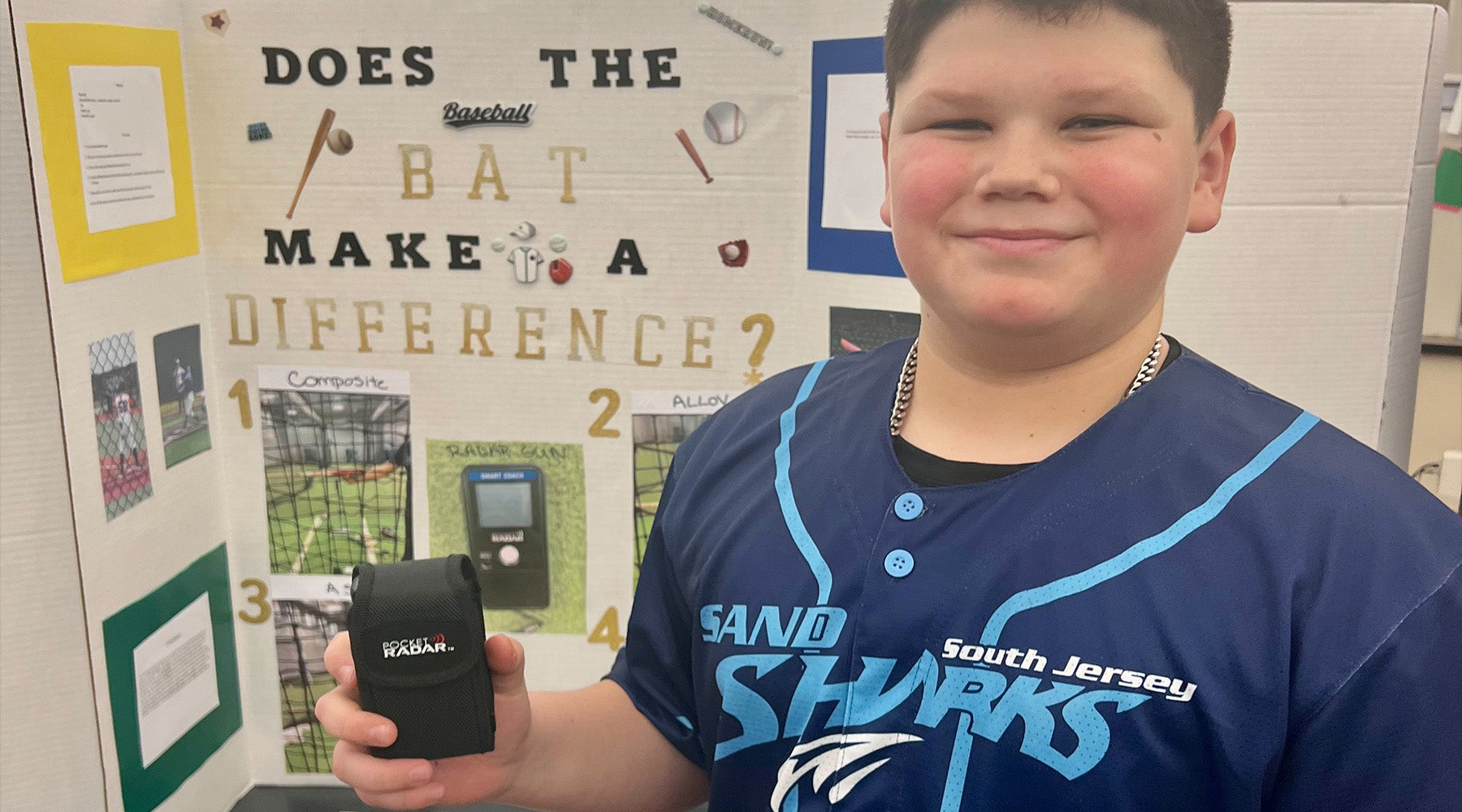
We were recently paid a visit to the 2011 California Science Fair to meet with Kyle Lin, a Santa-Rosa High School student whose science fair project used Pocket Radar to study the effect that building rectus abdominis muscle strength or increasing wrist flexion has on tennis service velocity. Kyle used Pocket Radar to measure the serve velocity of each of the test groups over a 6-week period and documented his results. We had the chance to learn more about Kyle’s project and say congratulations on being selected as a 2011 California Science Fair exhibitor. Here is a video of Kyle telling us a little more about his project.
Radar History
“Welcome to Radar Nation, where the ideal velocities resemble temperatures in Phoenix in July.” In the April 4th edition of Sports Illustrated, writer Tom Verducci wrote a great article titled Radar Love; he included an overall history of how and where radar technology came about in the baseball industry. In 1946, at the Griffith Stadium in Washington, the Army tested a photo-electric cell to measure the speed of a fastball thrown by one of baseball’s greatest fastball pitchers Bob Feller of the Cleveland Indians as it entered the unit which was placed on home plate; unlike today’s radar that clocks the ball at peak velocity, right after it has left the hand of the pitcher. Richard Goldstein of the New York Times wrote that Feller threw 30 pitches that day with an average of about 98.6 miles an hour. Prior to this, Feller measured his pitch speed against a speeding motorcycle cop, according to Carl Note from the San Francisco Chronicle. Feller would throw a pitch in a parking lot and as he threw, a motorcycle cop would race alongside the pitch to measure its speed.
It wasn’t until 1973, when “Michigan State coach Danny Litwhiler, a former major league outfielder,” used a car cigarette lighter outlet powered radar gun from the campus police cars to clock pitchers. He soon discovered that after recalibrating the gun to read small objects and asking the company to make a version that was battery powered, the device became a very useful management tool for coaches.
In 1975 the Orioles and the Dodgers became the first adopters of the radar gun as a training tool. In 1978, nine major league teams were using radar guns and by 1980 radar guns were being used by all major league scouts.
Pocket Radar – Year In Review
From claiming speed records in the air, on the ground or in the water, to fastballs, auto racing, and downhill skiing, to playground cycling and running races, there is no doubt that the “need for speed” is deeply rooted in humankind.
In fact, speed is such a fascination that an entire television network is devoted to covering all things “fast,” aptly named The Speed Channel.
While this innate desire to “Go Fast” has led to many great innovations over the past few decades, the tools used to measure speed have not benefitted nearly as much from the same innovation.
This is precisely why a few years ago, we set out to usher in a new era in speed radar technology with the invention of the world’s only palm-sized speed radar device. We named it Pocket Radar, and its small size, light weight and extremely accurate speed measurements are transforming the way in which players, coaches, fans and everyday consumers experience the action.
Nearly 16 months since the launch at the 2010 Consumer Electronics Show (CES), Pocket Radar continues to capture the attention of industry, media and consumers alike for its groundbreaking combination of sleek, compact, ultraportable design and break-through speed radar technology that provides users with point-and-shoot functionality.
Interest in Pocket Radar has been widespread from both professionals and everyday consumers, including coaches clocking baseball pitch speeds, athletes seeking improved performance, hobbyists looking to measure the speed of RC cars, boats, or planes; racing fans looking to measure the speed of their favorite NASCAR driver while sitting in the stands; parents looking to measure the speed of the annual soap box derby race; concerned citizens needing to document reckless drivers in their neighborhood, and wildlife researchers needing to document the speed of wild animals on the African plains. The applications seem to be endless as we learn about new ways that consumers are using Pocket Radar every day.
We spent a lot of time traveling over the past year as we continue to meet with college and professional baseball and softball coaches, managers and players across the nation. We are proud to say that Pocket Radar is currently being used as a training aid by hundreds of NCAA softball and baseball programs including programs at The University of Arizona, University of Florida, Georgia Tech, Notre Dame, Purdue, Stanford, Texas A&M, Vanderbilt, and our local school at Sonoma State University; to name just a few.
The Pocket Radar gun was a big hit at the December 2010 Major League Baseball (MLB) Winter Meetings. Many pro teams have already started using the Pocket Radar in their programs. Some of the early adopters include the Los Angeles Dodgers, Oakland A’s, Chicago White Sox, Atlanta Braves and Washington Nationals.
Pocket Radar also received numerous awards and accolades including the 2010 Innovations Design and Engineering Award Honoree by the Consumer Electronics Association, the 2010 Popular Mechanics Editor’s Choice Award for best new product and most recently, we were awarded the Best of Show Award at the 2011 American Baseball Coaches Association (ABCA) convention.
But the greatest award is still the feedback that we get on a daily basis from Pocket Radar users letting us know the many different ways they are using the device in their everyday lives. So please keep it coming. Let us know how you use Pocket Radar. Send us videos or photos of Pocket Radar in action and we’ll share them with the Pocket Radar community.
Thanks for your support.
Sincerely,
Steve Goody, Chris Stewart and Grant Moulton
Co-Founders of Pocket Radar.
Jim Leonard: Head Softball Coach – King Philip High School states, “It is easy to use, easy to read, accurate….”
What a great product! I am so impressed with this little radar gun, which is as accurate as can be. We are using the Pocket Radar as a tool for both pitchers and catchers to make sure that they are maintaining their speed of pitches and throws to different bases.We have incorporated the Pocket Radar as part of our evaluation process for assignment of pitchers in our high school program during the pre-season. We have pitchers who rely on accurate measures in terms of velocity and accuracy to improve their performance and make necessary adjustments. The Pocket Radar has enabled us to improve our ability to provide meaningful feedback to our players without the constraints of a traditional radar unit.
In terms of scouting our opponents, we compete at the Division 1 level in Massachusetts. Having won the State Championship in 2010 we are striving for ways to know what we are up against as far as pitching. We can tailor our practices based on the information gained by effectively utilizing the Pocket Radar, as it is so accurate.
I plan on using the Pocket Radar for a long time to come for both self-scouting and scouting our competition. It is easy to use, easy to read, accurate and has become a necessity in our program. One of the best features is that it is so small and convenient which allows me to move from one drill to another without unnecessary delays. It has very quickly become a staple of our practices. Thank you!!
-Jim Leonard
Head Coach- Softball
King Philip High School
Wrentham, MA
Planet-Soaring:Pocket Radar Review
Aeromodellers have always been attracted by speed, if not addicted. But when you come to the speed evaluation, you quickly discover that people are very often optimistic (like measuring altitude). This is why a speed radar is interesting for our hobby.
If you don’t want to invest in an expensive radar gun, there is now a very convenient device that do the same for less money, but especially that will fit in your pocket, so that you can bring with you all the time. It has been made possible by using a much smaller, flat antenna to create the same type of signal that the horn creates in a radar gun.
I bought one for me few months ago. My objective is to have a means to measure the speed of my sailplanes when DSing.
The Pocket Radar has the size à a cell phone, and is able to measure the speed of moving objects from 11 to 600 km/h. It uses 2 standard AAA type batteries and comes with Alkaline batteries included. It comes in a very nice box that will protect it during transport.
Its accuracy is about +/- 2 km/h. If you point the radar at an object moving sideways, you won’t measure anything. This is what we usually call the Cosine error. Just remember some trigonometry when you where at school and you will quickly understand. Few figures: Within 8 degrees of angle from the moving line of the object you measure, the accuracy is about 1%, at 18 degrees it is about 5% of error, and it goes up to 30% of error with 45 degreed of angle.
The Pocket Radar is pretty easy to use: Hold the radar in your hand like a cell phone camera and simply press and release the big red button on the front of the Pocket Radar while pointing the moving object. When releasing the button, the measure will appear on the screen. If you do not release the big red button, the radar will continue to send out repeating small pulses and displaying a measure approximately every second.
You can configure the Pocket Radar with different speed units: MPH (Miles per hour), KPH(Kilometers per hour), FPS (Feet per second) and MPS (Meters per second).
To do so, just press and hold the black RECALL button. While holding the RECALL button down, press and release the big red button. Now release the RECALL button. The current selected units should blink (at the bottom of the display). Then each time you press and release the big red button, the units will advance to the next possible state (miles per hour, kilometers per hour, feet per second, meters per second).
Press and release the big red button until you see the units that you want to use blinking on the display. They will continue to cycle through each time you press the big red button. Finally, press and release the RECALL button and you will lock in the units displayed on the screen.
The Pocket Radar can store 10 measurements that you can scroll using the black “RECALL“ button.
2 Alkaline AAA batteries can provide up to 10,000 speed measurements which is not bad. The battery indicator on the LCD display will help you determine when to replace the batteries.
According to the manufacturer, the Pocket Radar can spot the speed of a car from about a 800 meters away or the speed of a baseball from up to 36 meters away.
I found the Pocket Radar to work pretty well for sailplanes. After a long dive, or while DSing, it always give a measurement. It is very seldom when it doesn’t display something.
More than that, as soon as I exit my Pocket Radar on the slope, everybody wanted to play, asking for a speed measurement of their plane.
You will see on this short video how easy it is to use the Pocket Radar:
In conclusion, the Pocket Radar is very nice device, that will cover most or our use. Of course if you are targeting the DS world record, then you will need another radar gun, factory modified to go higher than the 700 Km/h achieved today. For other pilots, the Pocket Radar give you a good progression margin before to hit its limit.
Manufacturer website: http://pocketradar.com/
Price: ~ 200$ USD
Coach Danny Hensley (Niceville High School Baseball): The Pocket Radar “turned out to be an awesome offensive weapon for our hitters.”
We gave Pocket Radar to the Niceville High School Baseball team. in Niceville, FL. Coach Danny Hensley gave it a great review. Here’s what he said:
I have been in the coaching business for over 20 years and love it. I believe in order to be the best coach you can be, you need to continue brooding your knowledge and improve on your techniques in order to give your players the opportunity to develop and play at the highest level. Throughout my career I have tried numerous training devices and aids; so often they fail to hold up to their claim as being the new revolution in the sports world–that is so not the case with the Pocket Radar. This device instantly brought a great training device as well as an advantage to our ballclub. The first day I was able to give valuable information to my pitchers not only on the velocity they where throwing but also in the differential they where throwing between all their pitches. It allows us to tweak between the fastball and changeup, curveball, drop ball and others to attain what we felt was the ideal speed to throw each pitch. It also turned out to be an awesome offensive weapon for our hitters. We were able to determine the exact speed our opponents where throwing without them even noticing. This is a valuable piece of information for a hitter to have before they ever step into the batters box. Of all the training aids I have used over my career, this is certainly one of the most beneficial ones I have ever used.
ACE (Amateur Coaches Education) Baseball, Inc. Calls Pocket Radar “a must own for any coach at any level of baseball.”
We gave Pocket Radar to Ace (Amateur Coaches Education) Baseball, Inc. in Rocky River, OH . Program Director Neal Packanik gave it a great review. Here’s what he said:
The Pocket Radar is a great product to use when working with baseball players at any level. The convenience of the Pocket Radar far exceeds the use of a traditional radar gun. It is much smaller than a regular radar gun, yet it still performs at the same level and accuracy that we want when you are evaluating players. We are able to use the Pocket Radar during personal instruction, games, and camps. With it’s small size, we are able to bring the Pocket Radar anywhere with us, grab it out of the box and know it will be ready when we need it. Also, the ability for the Pocket Radar to run on two small batteries ensures that it will be ready to work when our athletes are ready to perform…never having to worry whether or not the radar gun is charged. The other great feature with the Pocket Radar is the recall button that is offered with the gun. The ability for us to recall the velocities of the last 10 pitches allows us to go over past velocities with players. This feature allows us to evaluate the difference in speeds for different pitches instantly, something that can be very time consuming with other radar guns. Having this option is very efficient and convenient because it allows us to review and evaluate previous pitches and velocity differences with our players by giving them a sampling of their recent pitches. The size, convenience, and accuracy of the Pocket Radar make it a must own for any coach at any level of baseball.
Harrison County High School Baseball Team Calls Pocket Radar “a tool that everyone will find invaluable.”
We gave Pocket Radar to the Harrison County High School Baseball Team recently to try out on the field. Coach Mac Whitaker gave it a great review. Here’s what he said:
For 33 years Kentucky High School Baseball has been my coaching occupation. During that entire time my teams have been fortunate to have a radar gun to assist our players with pitching and batting fundamentals.
During the January 2011 ABCA national baseball clinic in Nashville my coaching staff was able to see the new Pocket Radar on display. The representative was very knowledgeable and professional and his demonstration convinced us immediately we have to have one for our team.
In the past our staff was responsible for packing an inconvenient, bulky hand gun and case during our trips – having to search for the case since it would become misplaced on the bus or as part of the luggage. Not only was it cumbersome, but batteries and to be purchased along with spares and the hassle of recharging was time consuming and bothersome.
The Pocket Radar eliminates these problems and certainly will be an asset to our players and program. We have already begun using it during winter practice. It is so handy and actually we have hooked it on a small chain and attached it to a belt loop when in use. It is always available. Additionally, the ease with removing it from the pocket, replacing and continuing to scout and chart the workout of the pitcher has saved time and effort. The normal AAA batteries are simple to replace as needed.
It is highly recommended for any coaching staff of any level baseball team – especially high schools, colleges and universities – to purchase the Pocket Radar. Parents who participate in their children’s baseball activities will find this device simple and effective also. The price is unbeatable and affordable – the Pocket Radar is a tool that everyone will find invaluable.